
Professor Rui Yichuan’s team at the School of Chemistry and Chemical Engineering recently published a research paper entitled “Plasmon-driven light absorption and hole extraction in efficient tin-based perovskite solar cells” in the international journal Advanced Materials (impact factor: 29.1). The paper’s first author is Lin Siyuan, a master’s student from the School’s 2023 cohort, and Professor Rui Yichuan is the corresponding author. Shanghai University of Engineering Science is the first-listed affiliation, with Fudan University and Tsinghua University as collaborating institutions.
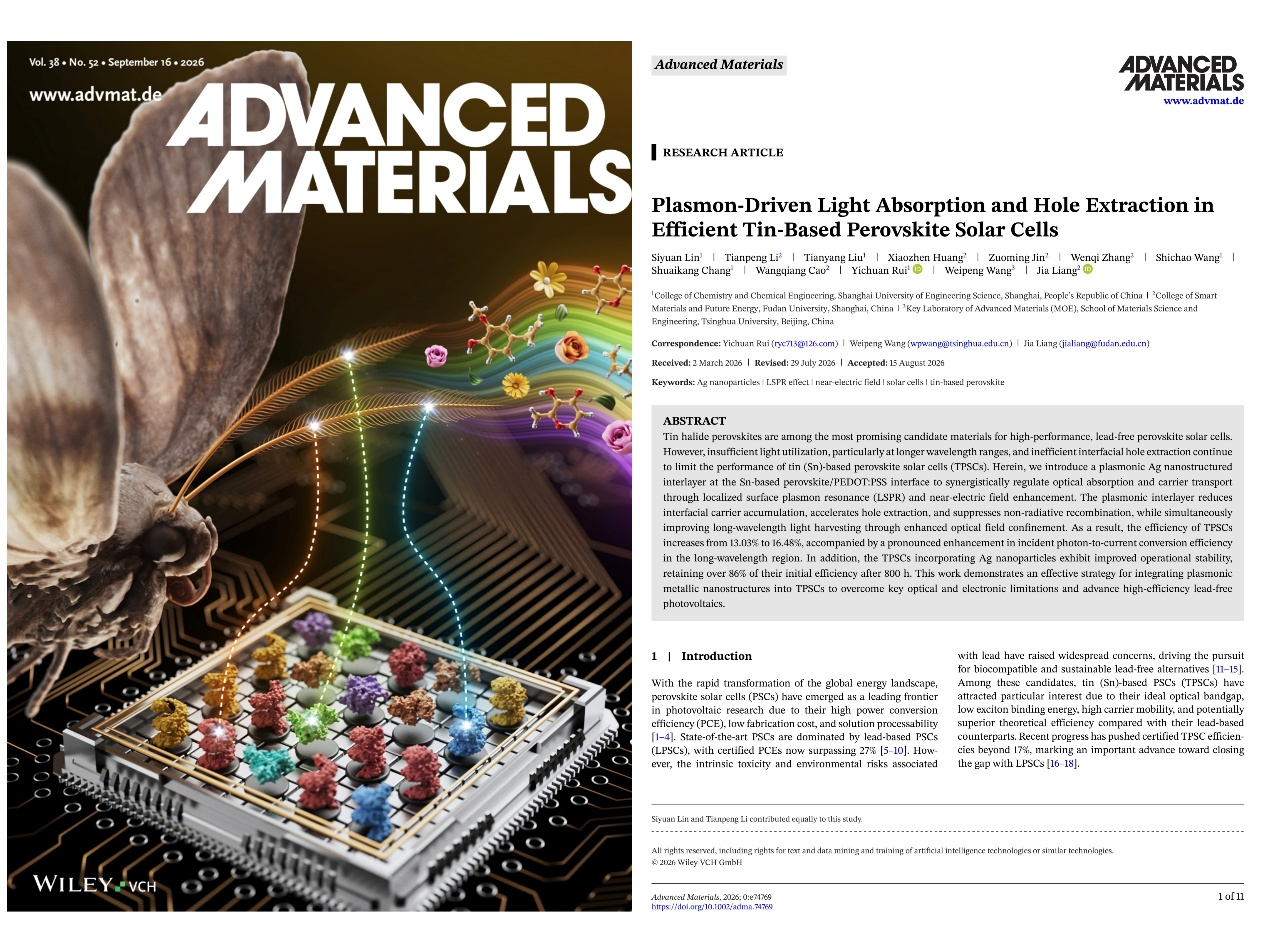
Developing efficient solar cells is an important way for China to accelerate the transformation of its energy mix and achieve its carbon peaking and carbon neutrality goals. With their high power conversion efficiency and low-cost fabrication, perovskite solar cells have been identified as a priority in renewable energy planning for the 15th Five-Year Plan period. As a lead-free alternative, tin-based perovskite solar cells (TPSCs) are among the most promising environmentally friendly perovskite photovoltaic technologies. However, limitations on the thickness of the tin perovskite absorber layer result in insufficient absorption at longer wavelengths. Meanwhile, energy-level mismatch at the buried interface between the hole transport layer and the perovskite causes severe non-radiative recombination, hindering further improvements in device performance.
To address these challenges, the team introduced an interlayer of plasmonic Ag nanostructures at the buried tin perovskite/PEDOT:PSS interface. Through localized surface plasmon resonance and near-field enhancement, the interlayer simultaneously modulated light absorption and charge carrier transport. It reduced interfacial carrier accumulation, accelerated hole extraction and suppressed non-radiative recombination, while substantially improving light harvesting at longer wavelengths through enhanced optical field confinement. The team thereby achieved simultaneous improvements in power conversion efficiency and long-term operational stability in tin-based perovskite solar cells, offering a new interface engineering strategy for developing efficient, lead-free perovskite photovoltaic devices.
This research was supported by the National Natural Science Foundation of China, the Shanghai Natural Science Foundation, and the “Three Rotors” Exploratory Research Program of Shanghai University of Engineering Science.