
Associate Professor Lai Zhuangzhuang of the School of Chemistry and Chemical Engineering recently published a research paper as first author in Nature Catalysis, a leading international journal in catalysis. Entitled “The kinetic basis of bifunctional OX–ZEO catalysts for syngas conversion to light olefins,” the paper reports significant progress in understanding the kinetic fundamentals of syngas conversion to light olefins over bifunctional metal oxide–zeolite (OX–ZEO) catalysts.
OX-ZEO催化剂因在合成气直接转化制低碳烯烃中表现出优异的选择性而受到广泛关注。然而,该体系中氧化物与分子筛组分之间的协同催化机制长期以来缺乏清晰的理论认知,严重制约了催化剂的理性优化与设计。针对此关键科学问题,研究团队以ZnCrOₓ/丝光沸石(MOR)催化剂为模型体系,通过DFT计算获取了完整反应网络能量学数据,并创新性建立了扩散介导的双组分微动力学模型。该模型首次将金属氧化物表面的合成气活化过程、中间体的传质过程与分子筛孔道内CH₂CO催化转化过程在动力学层面定量耦合,结合平推流反应器(PFR)模型,实现了对OX-ZEO催化体系随时空演化的完整动力学描述。

OX–ZEO catalysts have attracted considerable attention for their excellent selectivity in the direct conversion of syngas to light olefins. However, a clear theoretical understanding of the synergistic catalytic mechanism between the oxide and zeolite components has long been lacking, severely limiting rational catalyst optimization and design. To address this key scientific question, the research team used a ZnCrOx/mordenite (MOR) catalyst as a model system. Density functional theory (DFT) calculations provided energetic data for the complete reaction network, enabling the team to develop a diffusion-mediated, two-component microkinetic model. For the first time, this model quantitatively coupled syngas activation on the metal oxide surface, mass transfer of intermediates and catalytic conversion of CH2CO within zeolite channels at the kinetic level. Integration with a plug-flow reactor (PFR) model enabled a comprehensive kinetic description of the spatial and temporal evolution of the OX–ZEO catalytic system.
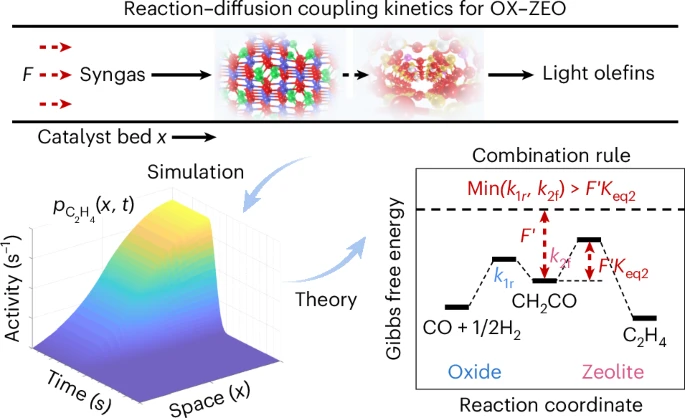
The team established a generalized kinetic model coupling reaction and diffusion in OX–ZEO systems and derived universal principles and quantitative formulas for catalyst optimization: an expression for the optimal space velocity, F′opt = (k1r × k2r)1/2, and a criterion for optimal component matching, Min(k1r, k2f) > F′Keq2. These results provide a quantitative basis for designing the next generation of high-performance OX–ZEO catalysts. The model’s predictions agreed closely with experimental data and suggested several promising new component combinations, including ZnVOx and Ga/Sc-doped MOR zeolites. The theoretical insights have broad implications for understanding synergy in OX–ZEO catalytic systems and offer new approaches to describing other related tandem catalytic processes.